
April 2026
How Much Tummy Time at 2 Months and 3 Months?
Plagiocephaly is one-sided head flattening, while brachycephaly is symmetrical flattening across the back of the head.
These positioning-related head shape changes are common between 2 and 6 months of age, when a baby’s skull is growing quickly.
The American Academy of Pediatrics and institutions such as Cleveland Clinic recognize positional head shape changes as common in early infancy. This does not automatically mean there is a problem with brain growth, as these conditions usually affect outer skull shape rather than brain development.
Why tummy time matters for development
When babies lie on their stomach while awake, they activate extensor muscles along the spine that help them lift and control their head. This strengthens the neck, shoulders, and upper body. These muscles are important for rolling, pushing up, and later sitting.
Regular movement also reduces repeated pressure on one part of the skull during the first 6 months, when skull growth is fastest. This is one of the key reasons early movement matters for preventing a flat head. For more on the underlying causes, read our guide on why do babies get flat heads.
What this looks like at 2 months
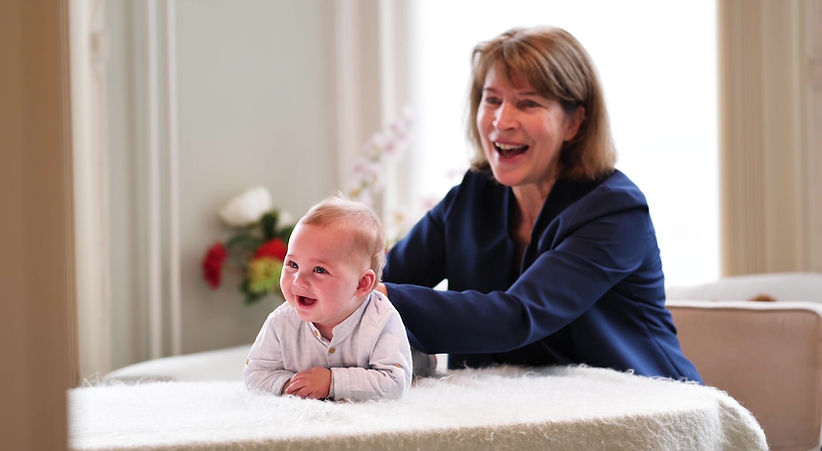
At 2 months, many babies tolerate 1 to 5 minutes at first. Building toward 3 to 5 short sessions per day is realistic. Some families practice several short sessions between morning naps.
By the end of this month, many babies briefly lift their head to about 45 degrees while on their stomach. The focus is repetition, not endurance. If you are just getting started, read our article on when to start tummy time for guidance on the earliest weeks.
What this looks like at 3 months
By 3 months, babies are usually stronger and can manage slightly longer sessions within the same short-session pattern. Some may total around 45 to 60 minutes across the entire day, divided into brief playful periods.
Many babies begin pushing up on their forearms and holding their head steady for several seconds. Tummy time does not need to be continuous to be effective.
Why side-lying is often more sustainable
Side-lying during awake and supervised time activates neck and shoulder muscles while placing less direct pressure on the stomach. Many babies tolerate this position longer than tummy time.
Side-lying supports balanced head turning and reduces pressure on the back of the head, which can help prevent positional flattening.
How side-lying and tummy time work together
Side-lying does not replace tummy time, but it complements it. Alternating positions allows babies to build strength gradually without becoming overly frustrated.
Pediatric physiotherapists often recommend this combined approach because it supports muscle symmetry and balanced head control. This steady practice leads to gradual improvement over weeks rather than sudden change.
What not to do
Tummy time and side-lying are only for awake and supervised periods. For sleep, always place your baby on their back on a firm, flat surface with no pillows, wedges, or positioners.
Tummy time does not treat craniosynostosis, and it should never be used during sleep to change head shape. Safe sleep guidance from major pediatric authorities remains the priority.
If you are noticing flattening or a strong side preference, a structured head shape scan can provide objective clarity instead of guessing.
How clinicians assess progress
Tummy time and side-lying are only for awake and supervised periods. For sleep, always place your baby on their back on a firm, flat surface with no pillows, wedges, or positioners.
Tummy time does not treat craniosynostosis, and it should never be used during sleep to change head shape. Safe sleep guidance from major pediatric authorities remains the priority.
If you are noticing flattening or a strong side preference, a structured head shape scan can provide objective clarity instead of guessing.
When to talk to a doctor
If by 3 months your baby cannot briefly lift their head, consistently tilts to one side, or avoids turning in one direction, it is reasonable to seek advice.
Early assessment can identify muscle tightness or movement patterns that respond well to simple positioning changes. Most head shape differences at this age are positional rather than structural. These movement patterns are also closely linked to torticollis in babies, where neck muscle tightness causes a preferred head position.
If you would like to track whether daily positioning is making a measurable difference, a scan can show objective progress over time.
Common questions parents ask
Is 5 minutes of tummy time enough at 2 months?
Yes, 1 to 5 minutes is appropriate at first and totals build gradually through repetition.
Does tummy time need to reach 60 minutes exactly?
No, strength develops step by step and tolerance varies between babies.
Is side-lying effective?
Yes, when done awake and supervised, it supports muscle development and reduces head pressure.
Should tummy time be done during sleep?
No, tummy time and side-lying are only for awake, supervised periods.
What if my baby cries every time?
Shorten the session, alternate with side-lying, and try again later to build tolerance gradually.

Writen by Elly van der Grift
Elly van der Grift is the co-founder of Skully Care and a pediatric physiotherapist with over 30 years of experience. Her mission is to provide top care for babies with skull deformities. With her infectious enthusiasm, she shares simple, effective tips that can make a big difference for your baby. Working with Elly, you'll feel confident and supported in your baby’s journey to better health.